
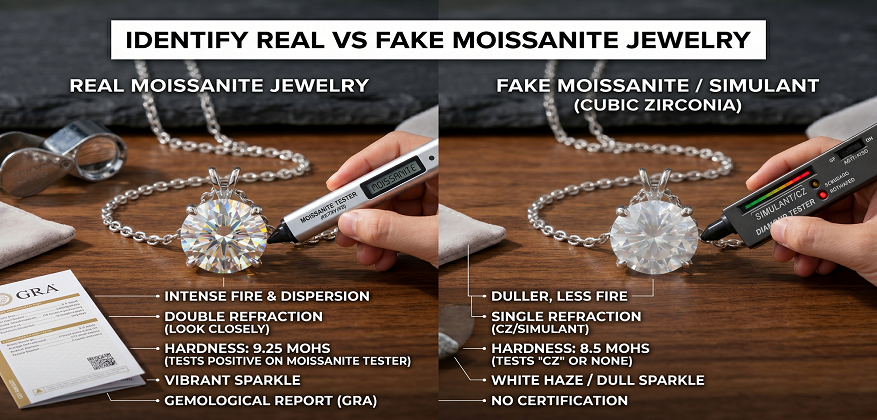
Why Authentic Moissanite Matters
Moissanite jewelry has become one of the most popular alternatives to traditional diamond jewelry. Known for its exceptional brilliance, durability, and affordability, moissanite is widely used in rings, chains, bracelets, pendants, and bust down watches. As demand continues to grow, the market has also seen an increase in imitation stones being sold as genuine moissanite.
For buyers investing in luxury jewelry, knowing how to identify real vs fake moissanite is essential. Authentic moissanite offers unmatched sparkle, long-lasting durability, and excellent value, while fake stones often lose their shine, scratch easily, and fail to deliver the quality consumers expect.
Understanding the key characteristics of genuine moissanite can help you make a confident and informed purchase.
What Is Real Moissanite?
Real moissanite is a lab-created gemstone made from silicon carbide. It was originally discovered in a meteor crater by French scientist Henri Moissan, but natural moissanite is extremely rare. Today’s moissanite is carefully created in laboratories using advanced technology.
One of the reasons moissanite is so popular is because it closely resembles a diamond while offering superior brilliance and a more affordable price. Genuine moissanite is highly durable, resistant to scratches, and maintains its sparkle for a lifetime.
Because of its growing popularity, some sellers attempt to pass off lower-quality stones such as cubic zirconia or glass as moissanite.
Examine the Sparkle and Fire
One of the easiest ways to identify real moissanite is by observing its sparkle.
- Real Moissanite
Authentic moissanite displays intense brilliance and colorful flashes of light known as fire. Because moissanite has a higher refractive index than diamonds, it produces vibrant rainbow reflections when exposed to light.
Under sunlight or bright indoor lighting, real moissanite creates a dazzling display of sparkle that is difficult to ignore.
- Fake Moissanite
Imitation stones often appear dull or overly glass-like. While some fake stones may initially sparkle, they typically lack the depth, fire, and brilliance of genuine moissanite.
If the stone appears lifeless or lacks colorful flashes, it may not be authentic moissanite.
Check the Clarity and Appearance
High-quality moissanite is carefully manufactured to provide excellent clarity.
- Real Moissanite
Most premium moissanite jewelry uses VVS or near-flawless stones. These stones appear clean and transparent, with very few visible inclusions.
When viewed closely, genuine moissanite has a crisp and luxurious appearance.
- Fake Moissanite
Many imitation stones contain visible imperfections, bubbles, cloudy areas, or inconsistent coloring. Cheap replicas may also appear overly clear in an unnatural way, lacking the depth and structure found in real moissanite.
Examining the stone carefully can reveal signs of poor-quality imitations.
Use a Jewelry Loupe
A jewelry loupe is one of the most useful tools for identifying genuine moissanite.
When viewed under magnification, moissanite often displays a unique characteristic known as double refraction. This optical effect causes the facets inside the stone to appear slightly doubled.
- Real Moissanite
Under a loupe, you may notice doubled facet lines, especially when viewing through the side of the stone. This is a common indicator of authentic moissanite.
- Fake Moissanite
Cubic zirconia, glass, and other imitation stones do not display this distinctive double-refraction effect.
While this test requires some experience, it can be highly effective in distinguishing real moissanite from fake alternatives.
Perform a Hardness Test
Moissanite is one of the hardest gemstones used in jewelry.
- Real Moissanite
Moissanite ranks 9.25 on the Mohs hardness scale, making it highly resistant to scratches and everyday wear.
- Fake Moissanite
Many imitation stones, including cubic zirconia and glass, are much softer and more susceptible to scratching. Over time, fake stones often lose their polish and become cloudy.
Although you should never intentionally damage jewelry, signs of scratching on a relatively new piece may indicate that it is not genuine moissanite.
Verify With a Diamond Tester
Many people are surprised to learn that moissanite can often pass a standard diamond tester.
This is because both diamonds and moissanite conduct heat efficiently.
- Real Moissanite
A basic diamond tester may register moissanite as a diamond due to its thermal conductivity.
- Fake Moissanite
Glass and many imitation gemstones usually fail thermal conductivity tests.
However, modern jewelers often use specialized moissanite testers that can accurately distinguish moissanite from diamonds and other simulants.
Request Certification
One of the most reliable ways to verify authenticity is by requesting a certificate of authenticity.
- Real Moissanite
Reputable jewelers typically provide certification detailing:
- Stone type
- Carat weight
- Clarity grade
- Color grade
- Authenticity verification
Certificates offer peace of mind and confirm that the jewelry contains genuine moissanite.
- Fake Moissanite
Untrustworthy sellers may not provide any documentation or may offer vague descriptions without proper certification.
Always ask for proof of authenticity before making a significant purchase.
Buy Moissanite Jewelry From Trusted Sellers
The easiest way to avoid fake moissanite jewelry is to purchase from a trusted vendor like Kermis Luxury.
Look for sellers that:
- Provide detailed product descriptions
- Offer authenticity certificates
- Have positive customer reviews
- Clearly state stone specifications
- Offer return and warranty policies
Kermis Luxury sells only genuine moissanite and stands behind the quality.
Common Stones Mistaken for Moissanite
Several gemstones are often used as substitutes for moissanite, including:
- Cubic Zirconia (CZ)
Affordable and shiny but less durable and less brilliant than moissanite.
- Glass Stones
Very inexpensive but prone to scratching, clouding, and breakage.
Crystal Simulants
Offer temporary sparkle but lack the durability and brilliance of genuine moissanite.
Knowing these alternatives can help buyers avoid confusion when shopping for jewelry.
Conclusion
As moissanite jewelry continues to grow in popularity, understanding how to identify real vs fake moissanite is more important than ever. Genuine moissanite offers outstanding brilliance, durability, and value, making it one of the best choices in modern luxury jewelry.
By examining sparkle, clarity, hardness, certification, and seller reputation, buyers can confidently distinguish authentic moissanite from imitations. Whether you’re purchasing a men’s moissanite chain, ring, bracelet, pendant, or watch, taking the time to verify authenticity ensures you receive the quality and luxury you deserve.