
Choosing a moissanite isn’t just about finding a “diamond alternative”—it’s about selecting a high-performance, lab-grown gemstone with its own unique optical properties. In 2026, savvy buyers are looking beyond the price tag to understand the technical precision that separates a “forever” stone from a cloudy imitation.
This guide breaks down the essential quality markers you need to know before you buy.
1. The Color Scale: Beyond “White”
While moissanite is graded similarly to diamonds, the way it handles light is different. In 2026, the industry has moved toward three primary color categories:
- D-E-F (Colorless): The gold standard. These stones are icy white and show no hint of yellow, even in larger carat weights.
- G-H-I (Near-Colorless): Offers incredible value. These stones have a slight warmth that often looks more “natural” in yellow or rose gold settings.
- Fancy Colors: Lab-grown technology now allows for stable, high-quality colors [Yellow, Pink, Gray, Green, Blue, etc.] that maintains its hue for a lifetime.
Expert Tip: If you are buying a stone larger than 3 carats, always opt for D-F colorless to ensure the stone doesn’t show a “dull” tint in low-light environments.
2. Clarity: The “Eye-Clean” Standard
Because moissanite is created in a controlled lab environment, it typically has fewer inclusions than mined stones. However, “Flawless” isn’t always necessary for beauty.
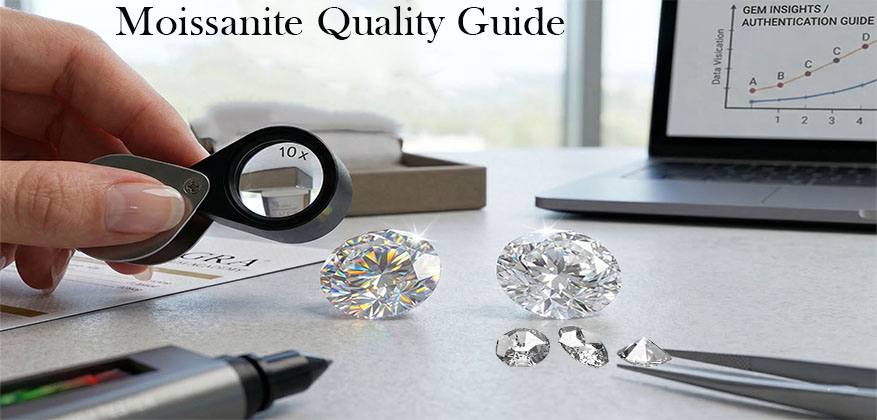
- VVS1/VVS2: These are the most common high-quality grades. Inclusions are invisible to the naked eye and can only be seen under 10x magnification by a professional.
- VS1/VS2: Excellent for those on a budget. These stones are “eye-clean,” meaning you won’t see any spots or “needles” without a microscope.
3. The “Fire” vs. “Brilliance” Factor
Moissanite has a Refractive Index (RI) of 2.65 – 2.69, which is actually higher than a diamond’s 2.42. This results in the “rainbow effect” or “fire.”
| Feature | Moissanite | Natural Diamond |
| Hardness (Mohs) | 9.25 | 10 |
| Refractive Index | 2.65–2.69 | 2.42 |
| Fire (Dispersion) | 0.104 | 0.044 |
To ensure quality, look for Excellent Symmetry. Poorly cut moissanite can look “fuzzy” or “doubled” because of its double refraction. A precision-cut stone will have crisp, sharp facets that reflect light cleanly.
4. Why “Diamond Equivalent Weight” (DEW) Matters
Moissanite is roughly 15% lighter than a diamond. If you buy a 1-carat moissanite by weight, it will physically look larger than a 1-carat diamond.
To make shopping easier, most reputable 2026 retailers use DEW (Diamond Equivalent Weight).
Example: A 6.5mm Round Moissanite is listed as “1.0ct DEW” because it has the same visual dimensions as a 1-carat diamond.
5. 2026 Trust Check: How to Verify Quality
Amid the rise of low-quality mass-produced stones, make sure your jeweler offers:
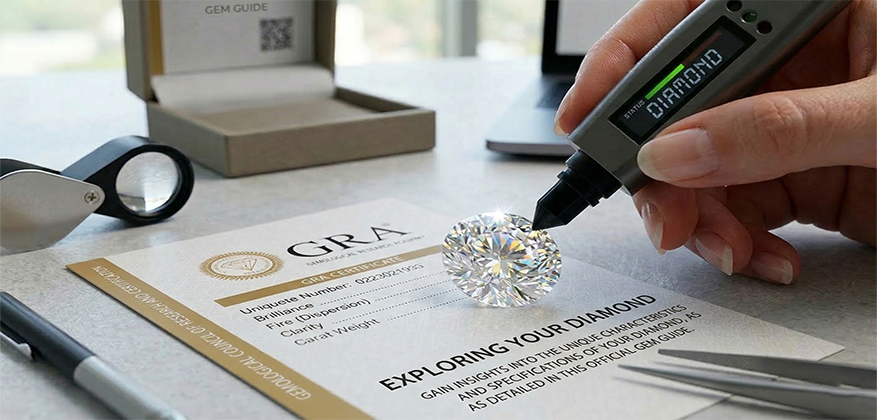
- A Physical Certificate: Look for reports from GRA or reputable in-house gemologists.
- A Lifetime Warranty: High-quality silicon carbide (moissanite) will never turn cloudy. If a brand won’t guarantee clarity for life, it may be a lower-quality simulant.
- Metal Purity: A high-quality stone deserves a high-quality home. Pair your gem with 14k Gold or Platinum.
Summary: What to Look For
Color: D-F for the most modern, “icy” look.
Clarity: VVS1 or VVS2 for total peace of mind.
Cut: “Excellent” or “Ideal” to maximize that famous rainbow fire.