
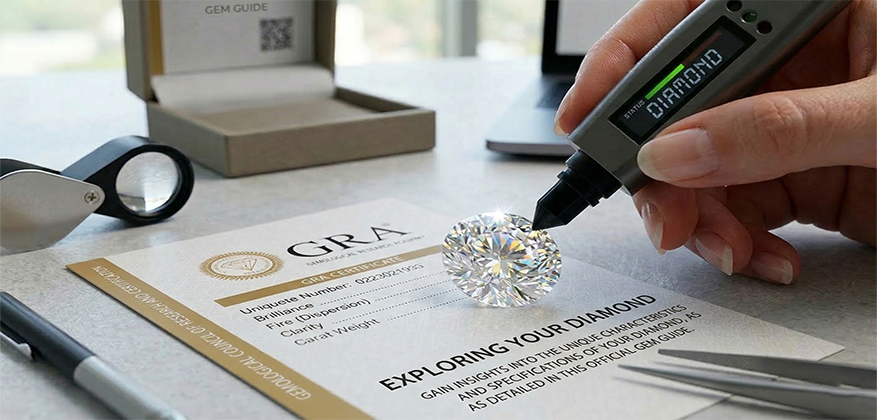
If you have been shopping for high-end Moissanite, you have likely seen the term GRA Certificate (Gemological Research Academy). A GRA certificate is the most common document used to verify the “4Cs” of a lab-grown stone.
But for most buyers, a GRA report looks like a page of random numbers. At Kermis Luxury, we believe a certificate is only valuable if you know how to read it. Here is your field guide to decoding a Moissanite report in 2026.
1. The Report Number & QR Code
At the top of every genuine GRA certificate is a unique Report Number.
- The 2026 Verification Tip: Modern GRA certificates feature a QR code. Always scan this with your smartphone. It should take you to the official GRA database website. If the digital record doesn’t match the physical paper in your hand, the stone is likely a low-quality simulant.
2. Shape and Cutting Style
This identifies the “Form” of your stone.
- Round Brilliant: The most popular for maximum fire.
- Fancy Shapes: Includes Oval, Pear, Princess, and Radiant.
- Measurements: These are listed in millimeters (Length x Width x Depth). For a 1ct DEW Round Moissanite, you should typically see 6.5 x 6.5 mm.
3. The 4Cs Grading Results
This is the heart of the certificate. This is where the value of your Moissanite is determined.
Carat Weight (DEW)
As discussed in our [Moissanite Quality Guide], Moissanite is lighter than diamond. The GRA certificate will list the “Carat Weight,” but keep in mind this is often the Diamond Equivalent Weight (DEW) to help you understand the visual size.
Color Grade
GRA uses the standard D through Z scale.
- Kermis Standard: We recommend sticking to the D-E-F range. In 2026, anything below a “G” may show a slight yellow or “oil” tint under natural sunlight.
Clarity Grade
This measures internal characteristics (inclusions).
- VVS1 / VVS2: “Very, Very Slightly Included.” This is the benchmark for luxury Moissanite. Even under a jeweler’s loupe, it is difficult to see any imperfections.
4. Proportions and Finish
Buyers often ignore this section, but it is actually more important than Carat weight for how much the stone sparkles.
- Polish: Look for “Excellent.” This means the surface of the stone is as smooth as glass, allowing light to enter without distortion.
- Symmetry: Look for “Excellent.” This ensures the facets are lined up perfectly. If symmetry is “Poor,” your Moissanite will have “dead spots” where it doesn’t sparkle.
- Fluorescence: Ideally, this should be “None.”
5. The Clarity Plot
On the right side of the certificate, you’ll see a diagram of a stone with small red marks. This is a “map” of your specific gemstone.
- Note: Since Moissanite is lab-grown, many VVS1 certificates will have a nearly clean map. If you see a lot of “Feathers” or “Clouds” on the map, the stone’s structural integrity might be lower.
Why Kermis Luxury Includes GRA Reports
A certificate is more than just paper—it’s a guarantee of resale value and authenticity. It proves that your stone isn’t just “cubic zirconia” or coated glass.
When you buy a Moissanite Tennis Chain or a custom moissanite pendant from us, the GRA report ensures that every stone meets our high-performance light standards.